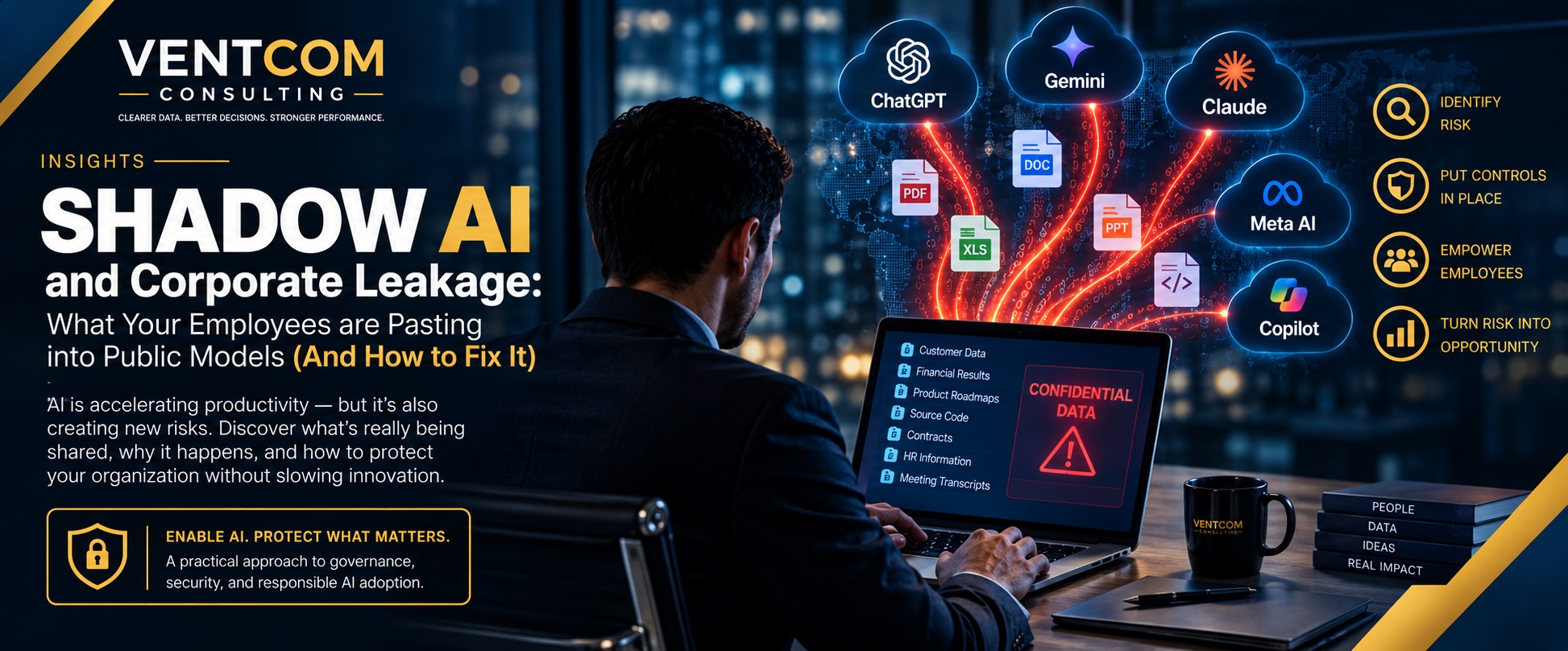
A brilliant employee wants to summarize a messy, 60-page internal financial forecast or quickly clean up a complex proprietary script before an afternoon deadline. To save time, they open a free public AI tool, hit paste, and get the job done in seconds.
To the employee, this feels like peak efficiency. To your organization, it may represent an invisible transfer of corporate data outside the environment you control.Executive takeaway: Shadow AI is not fundamentally an employee behavior problem. It is a governance problem. The solution is not to ban AI—it is to give employees a secure, governed alternative that is easier to use than the unapproved tools they already know.
The AI adoption you authorized and the adoption you didn't
Shadow AI refers to the use of AI applications, browser extensions, plugins, copilots, and other AI-enabled tools without formal approval or oversight from IT, security, or governance teams. The behavior is usually not malicious. Employees are trying to work faster. That can include:- Uploading internal financial forecasts for summarization.
- Pasting proprietary source code into an AI coding assistant.
- Submitting customer or prospect data to generate communications.
- Uploading contracts or legal documents for review.
- Using AI meeting assistants to capture confidential discussions.
- Connecting browser extensions to CRM, HR, or other enterprise applications.
Why public AI creates a governance blind spot
When employees submit corporate information to an unsanctioned AI service, the organization may lose visibility into how that information is stored, processed, retained, logged, or accessed. Policies vary substantially across providers, products, account types, and contractual arrangements. That makes an employee's personal or consumer AI account fundamentally different from an enterprise AI environment governed by corporate identity, security controls, retention policies, and contractual protections. The risk also extends well beyond familiar chatbot interfaces.- Meeting transcription tools can capture strategic conversations, client discussions, and internal decision-making.
- Code assistants and IDE extensions may interact with proprietary software repositories and development environments.
- Browser plugins can gain access to information displayed within CRM, HR, finance, or operational systems.
- AI productivity applications may connect directly to files, cloud storage, email, or collaboration platforms.
Key point: The question is no longer simply, “Did an employee access an AI website?” The more important question is, “Did sensitive corporate information leave an approved environment?”
Shadow AI is fundamentally a data governance problem
Organizations often treat Shadow AI primarily as a cybersecurity issue. Cybersecurity is an important part of the response, but the underlying challenge is broader. Shadow AI raises familiar data governance questions:- What information do we have?
- How is that information classified?
- Who is authorized to access it?
- Where is that data allowed to go?
- Which controls should follow the information?
- Who is accountable when AI is used to process it?
Why blanket AI bans do not solve the problem
The instinctive response to Shadow AI is understandable: block the applications. That can reduce some immediate exposure, but it does not eliminate employee demand for the capability. If approved corporate tools cannot provide the productivity employees have already experienced with generative AI, users may find alternative paths through personal accounts, mobile devices, browser-based applications, or newly released AI services that have not yet been identified by IT. That creates a dangerous outcome: leadership believes AI usage has been controlled while actual adoption becomes less visible. The better strategy is to make the secure way of using AI easier than the insecure way.The operating principle: Do not force employees to choose between productivity and security. Build an environment where they can have both.
The compliance and legal exposure
Depending on the data involved, the jurisdiction, the organization's contractual obligations, and how the information is processed, unauthorized AI usage can create exposure under privacy, healthcare, financial-services, cybersecurity, and corporate disclosure requirements.- Personally identifiable information: Customer and employee data may be subject to privacy requirements under frameworks such as GDPR, CCPA, and other state or national privacy laws.
- Healthcare information: Organizations subject to HIPAA must evaluate whether vendors handling protected health information operate under the required contractual and security arrangements.
- Financial and regulated information: Institutions may face additional obligations around confidentiality, vendor management, recordkeeping, and data handling.
- Material cybersecurity incidents: For public companies, cybersecurity incidents that are determined to be material can create SEC disclosure obligations, including reporting under Item 1.05 of Form 8-K.
The strategic fix: private knowledge bases and governed AI
An AI Acceptable Use Policy cannot physically prevent an employee from pressing copy and paste. In high-pressure environments, policy without a useful alternative creates friction rather than control. The more durable solution is to provide employees with a governed enterprise AI environment built around private knowledge bases, approved AI services, enterprise identity, secure data access, and defined usage controls. Private enterprise AI architectures can provide significantly greater control over how corporate information is accessed, processed, retained, and governed. Enterprise agreements and dedicated API services can also provide contractual commitments around data retention, security, privacy, and model training that may not exist when employees independently use consumer accounts. Building that environment requires three core pillars.1. Minimum Viable Governance
Governance should protect the organization without grinding productivity to a halt. A Minimum Viable Governance model focuses first on the controls that materially reduce risk while still allowing employees to work quickly.- Automated prompt inspection and filtering.
- PII and sensitive-data detection.
- Client-side masking or tokenization where appropriate.
- Real-time redaction before sensitive information leaves the application layer.
- Approved-use-case policies embedded directly into workflows.
- Logging and monitoring of enterprise AI activity.
2. Rigorous data lineage and quality tracking
A secure AI environment is only as trustworthy as the data feeding it. Before deploying an internal copilot or private knowledge assistant, organizations should understand where information originates, who owns it, how it has changed, and how it enters the AI retrieval process. That requires:- Defined data ownership.
- Source-system traceability.
- Data quality monitoring.
- Metadata and classification standards.
- Clear lineage into retrieval and AI workflows.
3. Granular role-based access control
A secure enterprise AI platform should respect the same organizational boundaries that govern access to the underlying information. If an employee is not authorized to view payroll records, executive strategy documents, legal files, or unreleased product information directly, an internal AI assistant should not be able to retrieve that information on their behalf. Role-Based Access Control, identity-aware retrieval, and permission inheritance help ensure that AI does not become an unintended bypass around existing security models. The result is an AI environment where employees can ask powerful questions while the platform continues to enforce who is allowed to see the answer.From Shadow AI to enterprise advantage
The rise of Shadow AI tells leadership something important: employees are actively searching for better ways to work. They are trying to eliminate repetitive tasks, summarize information faster, accelerate research, generate content, analyze documents, and improve decision-making. That demand should not be ignored. It should be captured. Organizations that build secure enterprise AI environments can turn unmanaged experimentation into governed innovation. Instead of viewing Shadow AI exclusively as a threat, leadership can use it as a signal of where automation, knowledge management, and AI-enabled workflows could create the most business value.Conclusion: enable AI, protect what matters
You cannot change the fact that employees want to use generative AI to work faster. What leadership can control is the environment in which that work happens. The organizations that respond to Shadow AI with policy alone will continue playing defense. The organizations that respond by modernizing their data foundation, establishing practical governance, and providing secure AI capabilities will be positioned to capture the productivity benefits without surrendering control of their most important information. Shadow AI is not simply an IT headache. It is evidence that the workforce is ready for a different operating model. The opportunity is to build it before unmanaged adoption builds it for you.Want help operationalizing this? VentCom works with leadership teams to assess Shadow AI exposure, establish Minimum Viable Governance, and design secure enterprise AI environments built on private knowledge bases, governed data access, RBAC, and measurable business outcomes.