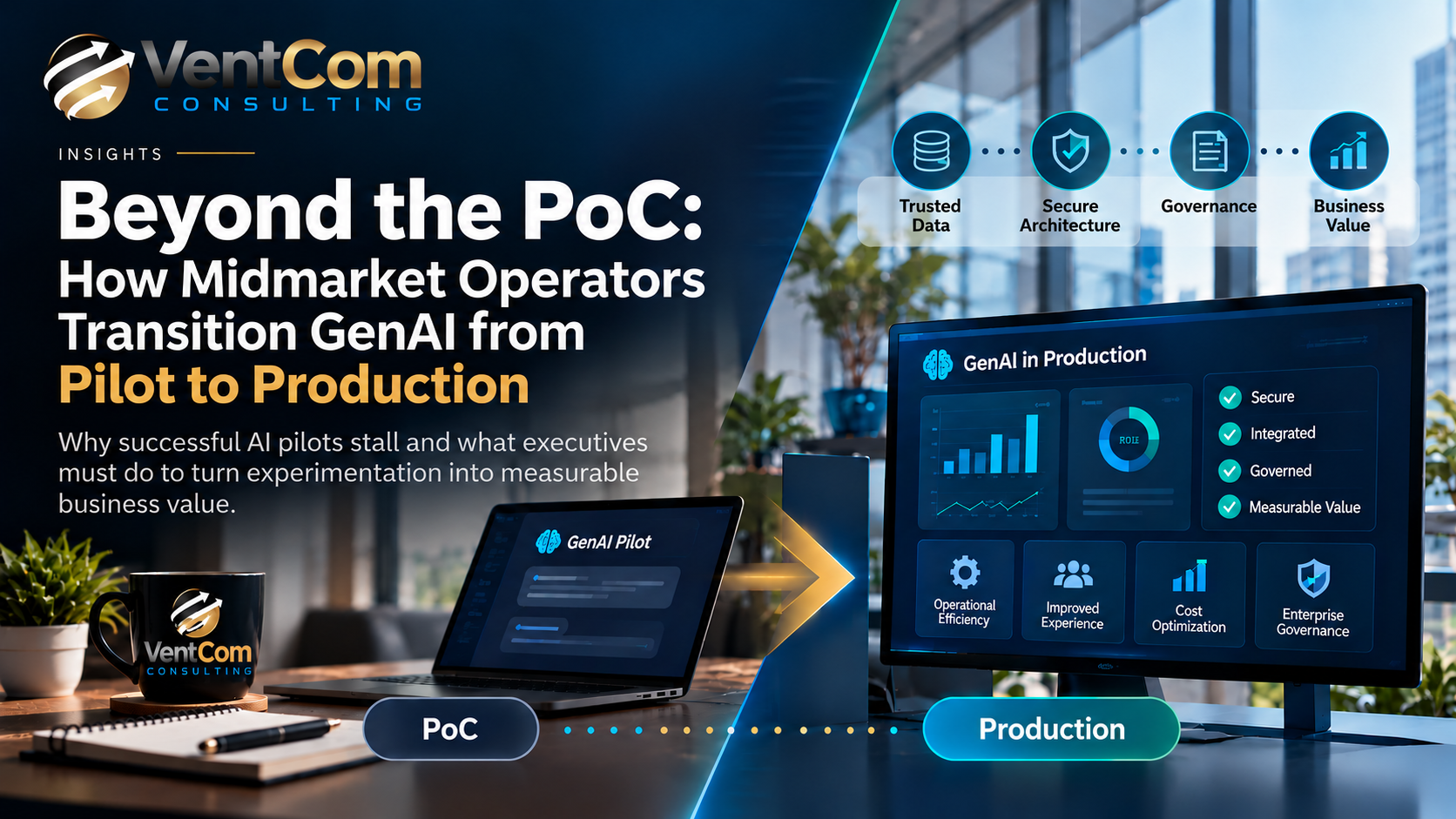
A midmarket company launches a generative AI pilot. The results are impressive. A process that previously took three hours now takes twenty minutes. Employees are enthusiastic and leadership sees an opportunity to reduce costs, improve productivity and accelerate decision-making.
Six months later, the solution is still a pilot. Integration with enterprise systems remains incomplete. Security has raised concerns about data access. No one has established operational ownership and the business cannot quantify the financial return. The technology worked. The business transformation stalled. This is the GenAI production gap, the difference between demonstrating what AI can do and delivering measurable enterprise value.
Executive takeaway: A successful pilot proves technical feasibility. Production success requires trusted data, secure integration, governance, operational ownership and a business case tied to measurable outcomes.
Why Promising GenAI Pilots Fail to Scale
Proof-of-concept initiatives are designed to answer one question: Can the technology perform the task? Production environments introduce a different set of requirements. Can the solution operate reliably across thousands of transactions? Can it securely access enterprise data? Can it integrate with existing workflows? Who handles exceptions when the model gets something wrong? Most importantly, can the organization demonstrate a measurable financial return? Many organizations underestimate the engineering and operational effort required to answer these questions. A chatbot that summarizes fifty curated documents is a successful experiment. An enterprise assistant that securely retrieves information across multiple systems, respects employee permissions and produces consistently reliable responses is a production capability.The mistake is treating production as an extension of the pilot rather than a separate operational discipline.
Start with Business Value, Not AI Capabilities
One of the biggest barriers to scaling GenAI is the absence of a clearly defined economic objective. Organizations often pursue use cases because the technology is impressive rather than because the business problem is financially meaningful. Consider a logistics company processing 10,000 shipment exceptions monthly. Each exception requires approximately eight minutes of employee effort. If an AI-enabled workflow reduces that handling time to three minutes, the company could recover approximately 833 labor hours per month. At a fully loaded labor rate of $45 per hour, that represents approximately $450,000 in annual labor capacity. However, recovered capacity does not automatically translate into EBITDA improvement. The financial benefit is realized when the organization reduces costs, avoids additional hiring, eliminates overtime or redeploys employees toward revenue-generating activities. That distinction matters.Productivity is an operational metric. Realized financial benefit is a business outcome.
Every GenAI production initiative should begin with a measurable baseline and a clearly defined path to financial value.The Three Pillars of Production-Ready GenAI
Moving beyond the PoC requires organizations to address three foundational capabilities.1. Trusted Enterprise Data and Architecture
AI cannot reliably deliver enterprise value without access to accurate, governed information. Production solutions must integrate with approved business systems, maintain data quality, respect access permissions and provide traceability into the information supporting generated responses. For many organizations, this means implementing secure enterprise AI endpoints and retrieval-augmented generation (RAG) architectures connected to trusted internal knowledge sources. The goal is not to build the most sophisticated AI platform. It is to establish an architecture that is secure, maintainable and appropriate for the business.2. Minimum Viable Governance
Governance should enable innovation, not prevent it. VentCom advocates a Minimum Viable Governance (MVG) approach that establishes the essential controls required for responsible deployment without creating unnecessary operational friction. This includes role-based access controls, sensitive data protection, model evaluation, audit logging, human oversight and clearly defined accountability. Introducing these controls early prevents the expensive redesigns and approval delays that frequently derail promising pilots.3. Operational Ownership and Workflow Integration
A production AI solution needs more than a technology owner. It requires a business sponsor accountable for outcomes, operational teams responsible for adoption and technical resources supporting reliability and ongoing improvement. Equally important, organizations must redesign workflows rather than simply automate isolated tasks. An AI tool that drafts a financial report faster creates efficiency. A governed workflow that retrieves approved data, identifies variances, prepares management commentary and routes exceptions for review can transform the reporting process.The greatest value comes from redesigning how work gets done, not simply making existing tasks faster.
A Practical 90-Day Path to Production
For a well-defined, moderate-risk use case, midmarket organizations can structure the transition around three phases.Days 1–30: Validate the Business Case
Establish measurable success criteria, assess data readiness, identify integration requirements, define governance controls and assign executive and operational ownership.Days 31–60: Engineer for Production
Build secure integrations, implement access controls, establish monitoring and evaluation and test reliability, performance and exception handling.Days 61–90: Deploy, Measure and Optimize
Launch to a controlled production group, measure outcomes against the original baseline, address adoption barriers and determine whether the solution is ready to scale. Complex or highly regulated use cases may require a longer timeline. The objective is disciplined progression, not deployment for its own sake.What Executives Should Measure
Once GenAI enters production, leadership should focus on four dimensions:- Financial impact: Realized cost savings, avoided expenses, revenue contribution and ROI.
- Operational efficiency: Cycle time reduction, throughput, employee capacity and adoption.
- Quality and reliability: Accuracy, exception rates, response times and service availability.
- Governance and cost: Policy compliance, data security, auditability and cost per successful workflow.
The Bottom Line
Generative AI has already demonstrated its technical potential. The next competitive advantage for midmarket organizations will come from converting a smaller number of high-value use cases into reliable, governed production capabilities. That requires leadership to move beyond experimentation and establish the data foundation, architecture, governance and operating model necessary to deliver measurable results.A pilot proves what AI can do. Production proves what AI is worth.