Artificial Intelligence has officially moved from experimentation to enterprise strategy. Across industries, leadership teams are asking the same question:
“Which Large Language Model (LLM) should we deploy within our organization?”
The challenge is not a lack of options. It is the opposite.
Today’s market includes models from OpenAI, Anthropic, Google DeepMind, Meta AI, Mistral AI, and others — all claiming superior reasoning, lower costs, faster response times or enterprise grade security.
But selecting an LLM is not simply a technical decision.
It is a strategic business decision that impacts:
- Data security
- Employee productivity
- Customer experience
- Operational scalability
- Governance and compliance
- Long term AI roadmap flexibility
Organizations that approach LLM adoption like a technology purchase often struggle. Organizations that approach it like a business capability transformation tend to see measurable returns.
At VentCom Consulting, we advise clients to begin with business objectives first then align the AI architecture to those goals.
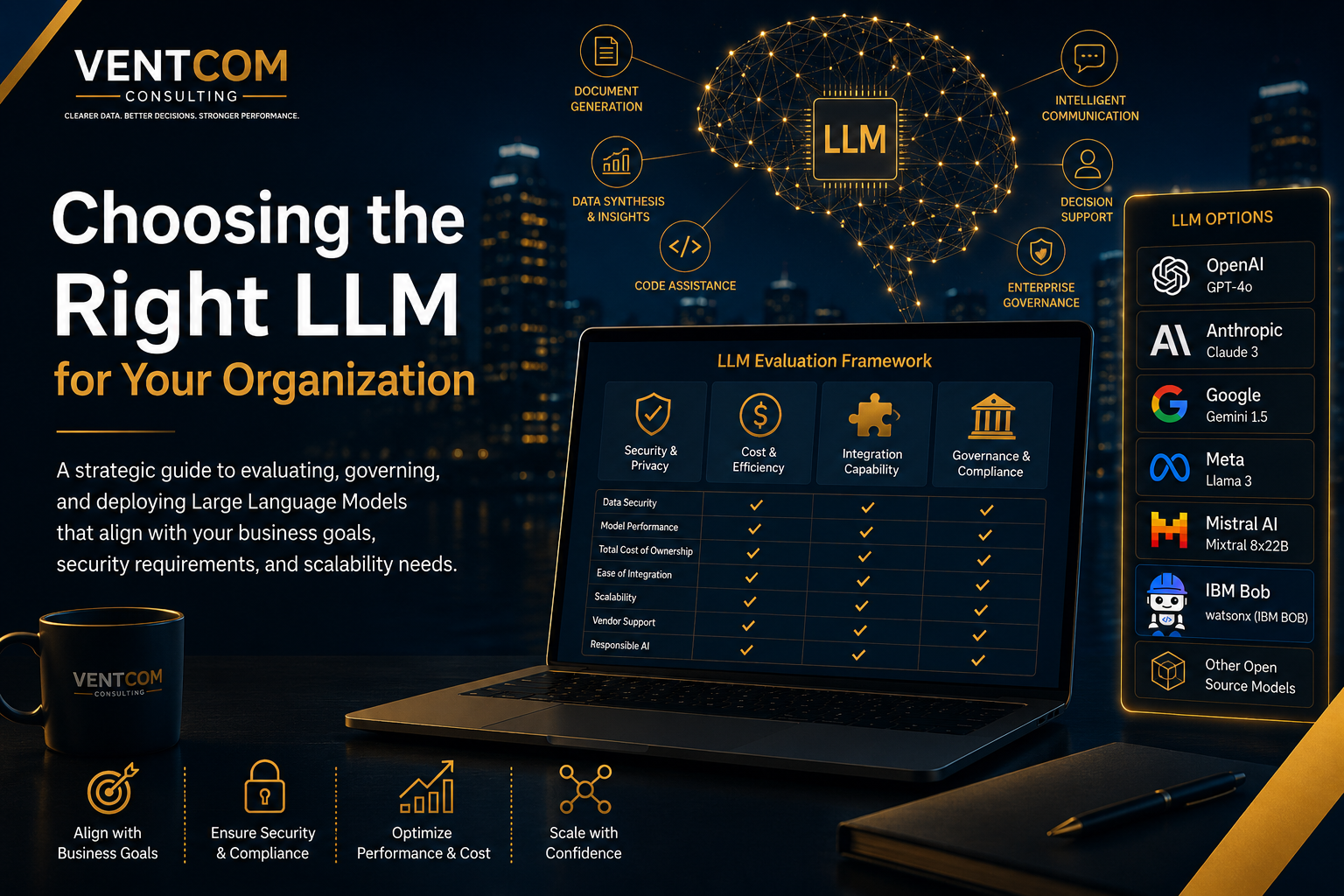
Here is the framework we use to help organizations make the right decision.
Step 1: Define the Business Outcome Before Evaluating Models
Most companies start by comparing benchmarks.
That is the wrong starting point.
The first question should be:
“What business capability are we trying to improve?”
Different LLMs excel at different tasks.
Examples:
- Customer support automation
- Internal knowledge management
- Software development assistance
- Executive reporting
- Analytics copilots
- Document summarization
- Sales enablement
- Legal or compliance review
- AI-powered search
- Workflow orchestration
A healthcare organization focused on compliance sensitive documentation may prioritize accuracy and security.
A software engineering company may prioritize coding performance and API flexibility.
A customer support operation may prioritize speed, multilingual support and cost efficiency.
Without clearly defining the business use case, organizations often overpay for capabilities they do not need or deploy models that fail under operational requirements.
Step 2: Understand the Major LLM Categories
The market can generally be divided into four categories.
Frontier Proprietary Models
Examples:
- OpenAI GPT models
- Anthropic Claude models
- Google Gemini models
Advantages
- Strong reasoning capabilities
- High-quality outputs
- Rapid innovation
- Mature APIs and tooling
- Excellent multimodal capabilities
Considerations
- Higher operating costs
- Vendor dependency
- Limited transparency into model training
- Data governance concerns depending on deployment architecture
These models are often ideal for enterprises prioritizing performance, innovation and speed to market.
Open-Source Models
Examples:
- Meta Llama
- Mistral AI Mistral
- Databricks DBRX
Advantages
- Greater deployment flexibility
- Lower long term inference costs
- Ability to fine tune internally
- Stronger control over data privacy
Considerations
- Requires internal AI engineering expertise
- Infrastructure costs can rise quickly
- Performance may lag frontier models in advanced reasoning tasks
These models are ideal for organizations with mature data engineering teams and stricter governance requirements.
Domain Specific Models
These are models optimized for industries such as:
- Healthcare
- Legal
- Financial services
- Cybersecurity
- Life sciences
Advantages
- Better domain context
- Reduced hallucinations within specialized workflows
- Faster business alignment
Considerations
- Narrower applicability
- Potential vendor lock in
- Smaller support ecosystems
Organizations in highly regulated industries often benefit significantly from domain specific AI approaches.
Hybrid AI Architectures
This is rapidly becoming the preferred enterprise approach.
Rather than relying on a single LLM, organizations orchestrate multiple models together.
Example:
- Frontier model for reasoning
- Open source model for internal workflows
- Lightweight local models for edge processing
- Specialized models for regulated tasks
This strategy improves:
- Cost optimization
- Performance tuning
- Risk management
- Vendor diversification
The future of enterprise AI is likely multi-model rather than single-model.
Step 3: Evaluate the Critical Decision Factors
1. Data Privacy and Security
This is often the single most important factor.
Leadership teams should evaluate:
- Where data is stored
- Whether prompts are retained
- Model training policies
- Tenant isolation
- Encryption standards
- Regulatory compliance alignment
Industries handling:
- PHI
- PII
- Financial records
- Government data
must conduct deeper governance reviews before deployment.
A powerful model with weak governance controls creates enterprise risk.
2. Accuracy vs. Creativity
Not every use case needs maximum creativity.
For example:
- Marketing content benefits from generative flexibility
- Financial reporting requires precision
- Legal workflows require consistency and traceability
Organizations should align model selection with acceptable hallucination tolerance.
This is one of the most overlooked parts of AI deployment planning.
3. Cost Structure
Many organizations underestimate operational AI costs.
LLM pricing considerations include:
- Token usage
- Concurrent users
- API call volumes
- Fine tuning costs
- GPU infrastructure
- Storage and retrieval architecture
- Context window utilization
An enterprise scale deployment can shift from a pilot budget to a seven figure operational expense surprisingly quickly.
A proper AI strategy includes financial governance from day one.
4. Integration Capabilities
The best LLM is useless if it cannot integrate into operational systems.
Key integration areas include:
- CRM platforms
- ERP systems
- Data warehouses
- Knowledge bases
- Security tools
- BI platforms
- Internal APIs
Organizations should evaluate how easily the LLM ecosystem integrates into existing workflows.
AI adoption succeeds when employees barely notice the technology because it fits naturally into operations.
5. Governance and Responsible AI
AI governance is no longer optional.
Executive leadership should establish:
- AI usage policies
- Human review requirements
- Model monitoring
- Bias testing
- Audit logging
- Access controls
- Prompt governance standards
The organizations seeing the best AI outcomes are building governance frameworks simultaneously with deployment.
Step 4: Decide Between Cloud, Private or Hybrid Deployment
This decision dramatically impacts scalability and security.
Cloud Hosted AI
Best for:
- Rapid deployment
- Lower infrastructure management
- Innovation speed
Risks
- Data exposure concerns
- Ongoing API costs
- Vendor concentration
Private LLM Deployment
Best for:
- Sensitive enterprise data
- Regulated industries
- Custom fine tuning
Risks
- Higher operational complexity
- GPU infrastructure costs
- Specialized staffing requirements
Hybrid Architecture
Increasingly the enterprise standard.
Organizations maintain:
- Sensitive workloads internally
- General reasoning externally
- AI orchestration layers between systems
This often provides the best balance between scalability and governance.
Step 5: Build an AI Roadmap, Not Just an AI Pilot
One of the biggest mistakes organizations make is deploying disconnected AI pilots.
Successful enterprises instead create:
- AI operating models
- Governance councils
- AI enablement programs
- Enterprise data strategies
- Long-term AI architecture plans
The LLM itself is only one component.
The competitive advantage comes from how AI integrates into decision-making, workflows and operations.
The Most Important Question Leadership Should Ask
Instead of asking:
“Which LLM is the smartest?”
Organizations should ask:
“Which AI architecture best supports our business strategy, governance requirements and operational goals?”
That shift in thinking changes everything.
Final Thoughts
The LLM market will continue evolving rapidly.
Models will improve. Costs will change. Vendors will consolidate. New architectures will emerge.
But the organizations that win with AI will not necessarily be the ones using the newest model.
They will be the organizations that:
- Align AI to measurable business outcomes
- Build scalable governance
- Integrate AI into operational workflows
- Treat AI as a strategic capability rather than a technology experiment
At VentCom Consulting, we help organizations design AI and analytics strategies that align technology decisions with real business value.
Because the goal is not simply deploying AI.
The goal is building intelligent organizations.